The store you operate by talking to it
Dream it. Say it. Sell it.
The friendliest way to start, run and grow your online shop. Just tell your store what you want, see every change before it happens, and undo anything in one click.
In beta. Free until you sell, and a real shop from the first minute.
Real product footage
Recorded in the demo shop. One take, nothing staged.
Why WhizzyCommerce
Not a smaller copy of the big platform. A different deal.
Free until you sell.
No monthly fee on Free: 2% of a sale, and only when an order is paid. Once you sell more, Pro is €49 a month and 0.5%, and the whole bill is never more than €499 in a month.
See what you would payEverything included.
Discount codes, gift cards, abandoned checkout emails, several currencies, a blog, translations and your own domain are in the box on both plans. No app store to pay for, month after month.
Every feature, line by lineBuilt for Portugal and Europe.
A dashboard in Portuguese, Spanish, Italian, French and English, prices in euro, payments on your own Stripe, PayPal or Mollie account, and certified invoices issued through your InvoiceXpress.
Your AI runs the shop.
Say what you want changed and see it before it happens. Every week it writes to you with what sold, what is running low and what it would do next, each as a change you confirm in one press.
How it worksNo lock-in.
No contract and no notice period. Your payment account and your domain were always yours, and the whole shop downloads as one file whenever you like.
Leaving Magento? We move you.
For the first 100 shops, a person on our side runs the move, checks it and keeps your URLs working. Free.
Ask for a free moveThe problem
Every admin is hundreds of screens, and every screen was somebody's fair request.
Every commerce platform's admin runs to hundreds of settings pages. None of that is carelessness. Each screen exists because a real merchant needed the thing on it, and once it exists it can never be taken away. The sprawl is structural, and it will keep growing for as long as merchants keep asking, which is forever.
All of it rests on one assumption: that a person will find the screen, and click through it. That is the assumption we dropped. The dashboard still reports and still confirms. It is no longer where the work happens.
How it works
Say it. See it. Confirm it. Keep the receipt.
01
Tell the shop what you want, in your words.
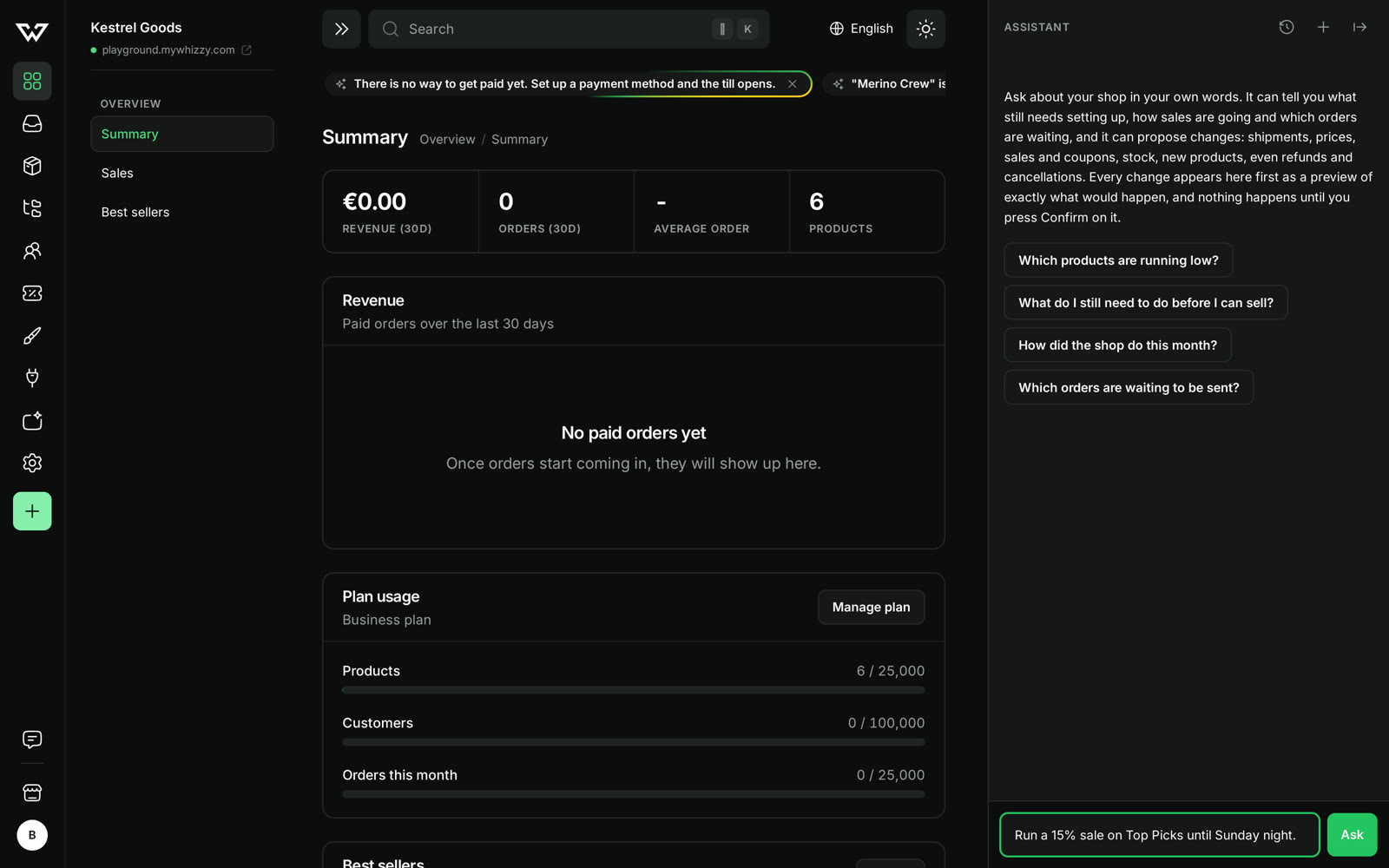
Run a 15% sale on Top Picks until Sunday night. No form to fill in, no screen to find. The assistant reads your categories, checks what is already running, and comes back with a proposal rather than a change.
02
See exactly what would change, before it does.
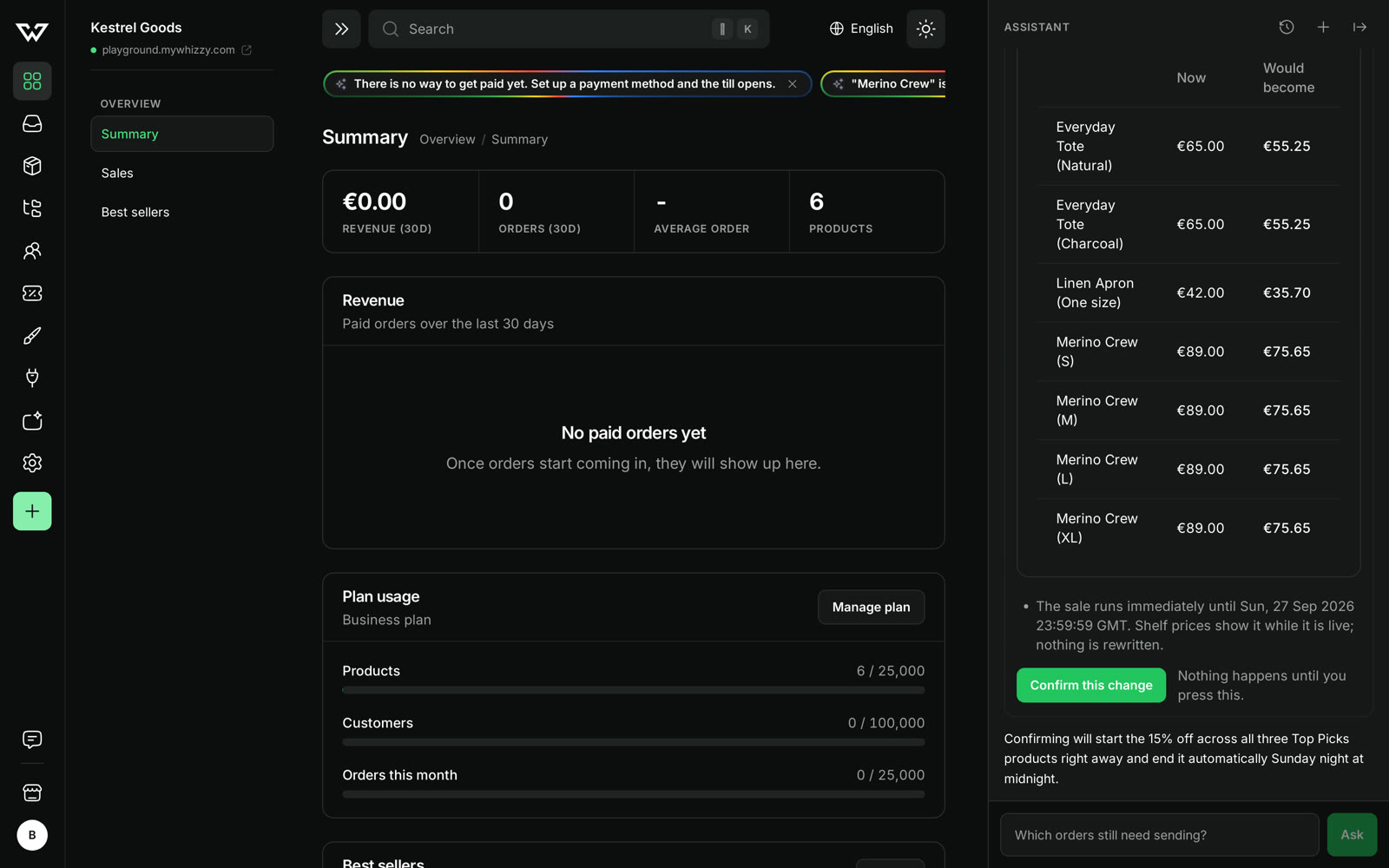
Every affected item, the price now and the price it would become, the total coming off the shelf, and a warning if another rule already discounts it. If nothing matches, it says so and stops there.
03
Nothing happens until you press this.
The confirm button is drawn by the dashboard, never by the agent. The agent proposes and gets no token back; the page you press mints its own, bound to the exact change it showed you. There is no code path by which an agent confirms its own work.
04
A receipt with two names on it.
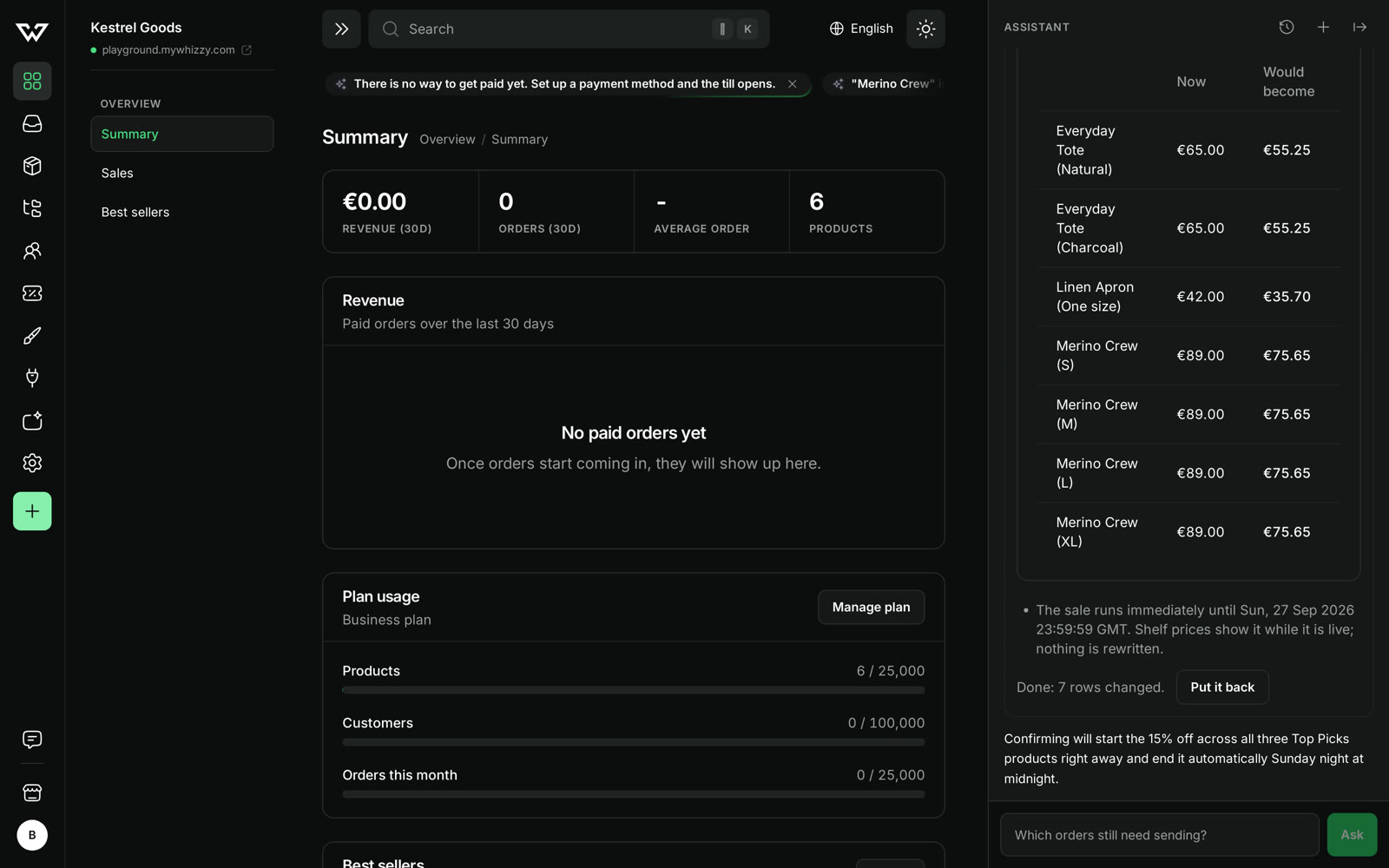
What changed, how many rows, who proposed it and who confirmed it. Agent actions and every money verb land in the shop's change log. It is not yet every write in the shop, and we say so rather than pretend.
05
Put it back, in one click.
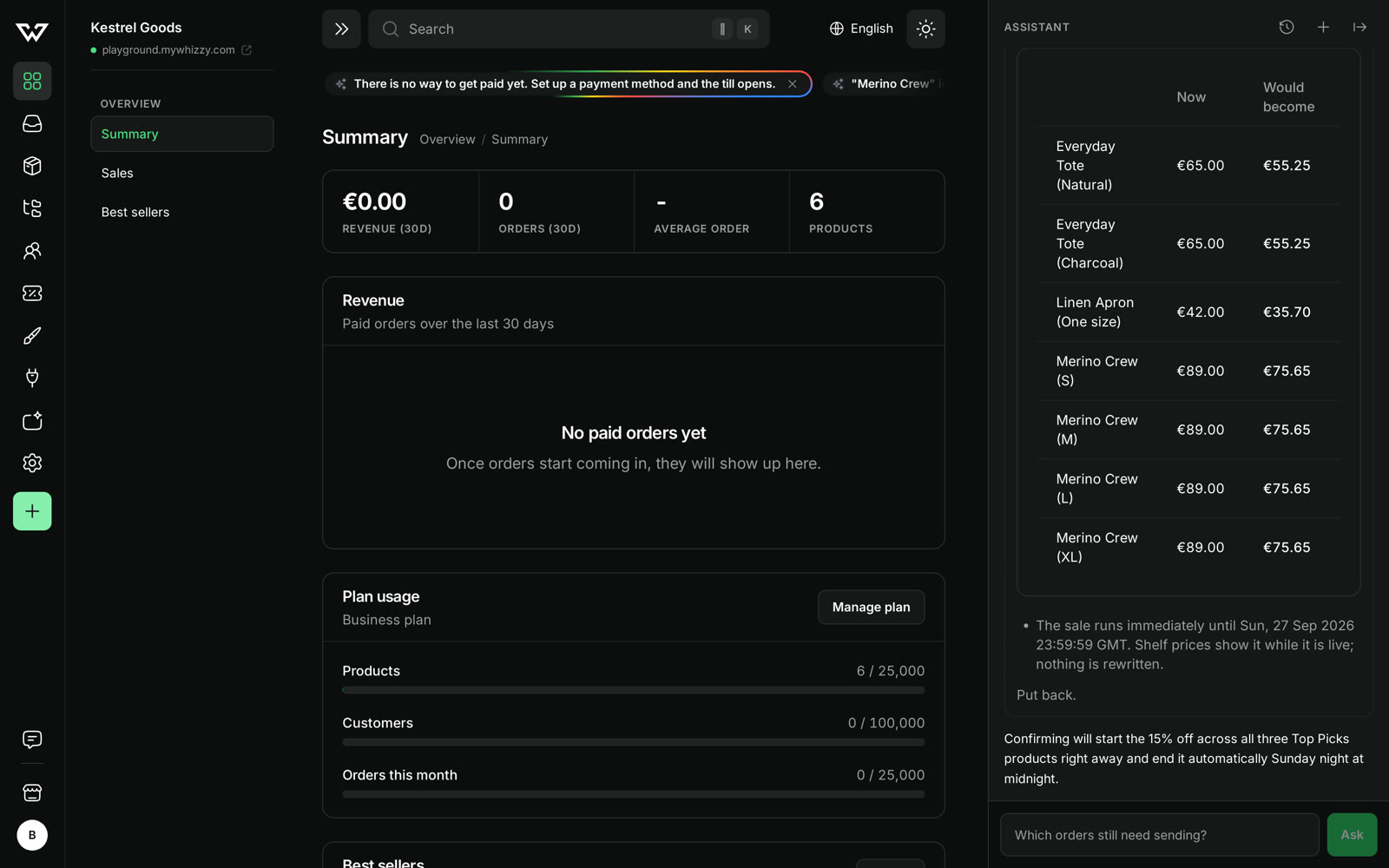
Every change reverts from its receipt, including each step of a multi-step plan on its own. The exception is deliberate: a refund that has already left cannot be quietly pulled back, so a refund is final and says so.
Trust
The agent proposes. You confirm. Everything else follows from that.
The confirm page is ours, not the agent's.
Anything that moves money or cannot be undone confirms on a page the dashboard draws. The agent never receives a confirm token. The page mints its own, tied to the exact diff it showed you, good for one use, and it runs the preview again before it commits; if the shop moved underneath, it refuses. There is no code path by which an agent confirms its own change.
Agents are named, and scoped.
Eleven grants, each its own key. A content agent that cannot touch a price. An analyst that can read everything and write nothing. An agent is not even shown the tools it lacks, and taking a grant away cuts a connector off mid‑conversation.
A log you can read by agent.
Every agent action and every money verb lands in the shop's change log, filterable by agent, with the proposer and the confirmer on each line. It does not yet cover every write in the shop, and we say so.
No starter agent template carries permission to move money. That grant is assembled by hand, by you, on an agent you already trust. And even then, every money move is a preview until you confirm it.
The beta
In beta, on purpose, and open.
Built and running
- Preview, confirm and one‑click undo on every consequential agent action, including each step of a multi‑step plan.
- Named agents with scoped grants, and a change log you can filter by agent.
- Catalogue, orders, fulfilment, discounts, customers and themes: a real shop, not a demo of one.
- Invoices and gapless credit notes, numbered per shop, issued from the first paid order.
- Works from Claude through the MCP connector on both plans, or from the panel inside the shop.
Not yet
- SAF‑T and e‑invoice exporters of our own. In Portugal, certified invoices already go through your InvoiceXpress account.
- Cost prices, so previews cannot yet warn about margin or selling below cost.
- A console for agencies running many shops. Designed, not built.
- A change log that covers every write in the shop, not only agent actions and money.
It suits a European merchant, or the agency running shops for them, who wants to be early and will tell us what is missing.
Try it on a real shop.
Free until you sell. Your own shop, and what you build stays when you go live.